Drupal
Drupal is one of the biggest and most well known Content Management Systems. It is usually used to run community web portal types of websites, but because it has many features and modules, it can be made to run almost any kind of website.
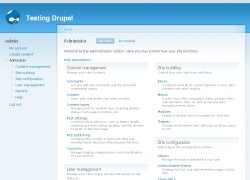


Current Version: 7.1.2
Cost: Free
Development: Community
Specialization: Web Portal
Hosting: Own Server
Source: Open Source
License: GNU GPL
Programming: PHP
Database: MySQL
Our Impressions:
Because of Drupal’s vastness, it can be made to run almost any kind of website. There is a large community, so finding help or modules should not be a problem. In short order, one can have a very feature-rich site up and running. Drupal also makes it very easy to keep custom modules, themes, and the core Drupal files up-to-date which is a huge bonus. Almost every menu and sidebar and little configuration can be changed without changing the theme. It has thousands of modules that can add on to its functionality.
Drupal can be intimidating to just logon to the system as an administrator. There are so many options and configurations and strange names like taxonomy that you don’t know where to start. Theming Drupal can be a large challenge if you are not a programmer.


Helpful Links:
- Drupal Home The home of the large project community
- Drupal Forum The best place to ask questions
- Dries Buytaert Drupal’s founder’s blog
- Drupal Theme Garden The Drupal Theme Garden, preview before downloading
- Suggest a Link
Related Site News:
User Reviews: Submit Your Own
You must be logged in to post a comment.
Voting has been open for this CMS since Sunday, January 4th, 2009. There are a total of 10 Reviews for this CMS. You can follow future reviews through the RSS feed if you'd like.

Review by James Moore August 11th, 2013 4:19 pm

Review by Review for Drupal 7 October 23rd, 2012 6:54 am
Strengths: Some of the community members are really friendly and helpful
Flexibility (which is mostly lost due the complexity and bugs)
Base theme is nice looking
Weaknesses: Poor documentation. Quote often things explained don’t work
Terribly difficult to develop in
Lots of bugs
Loads of errors
Non existent or expensive support
Lots of modules, almost too many to chose from, good luck finding them, but many with bugs or not finished
Needs a lot of server power to run well while similar platforms run easily
Sloooooooooooow in everything from development time to running.
Too steep a learning curve for what it is does
Messy database over time
Difficult and time consuming to run and maintain

Review by jammy August 14th, 2012 2:24 am
Strengths: • The architecture of Drupal is one of its biggest strengths. The node based architecture is easy to understand and implement.
• Drupal is an open source content management system; thus, is far from the concept of commercialization.
• Drupal has an active community, which is expanding at high rates.
• Drupal facilitates its users with Web 2.0 features that include easy tagging, commenting and blogging.
Weaknesses:
• Collaborative development is a bit complex in drupal. It requires huge times and more efforts.

Review by David July 21st, 2012 11:08 am
Strengths: With every CMS there are issues but drupal has all the nuts and bolts needs through modules that you would need to do pretty much anything with a site. It’s used widely on many big sites like the White House, MTV, Universal Music, Grammy, Emmy ect.
Weaknesses: If you are not clued up on CSS and PHP it can be a challenge.

Review by Eric November 27th, 2011 10:31 am
Strengths: Lots of modules.
Weaknesses: Poor performance. Poor design. Lot’s of half finished modules. Difficult to stage, and deploy updates. Often breaks when updated. No OOP Patterns. Overly complicated permission settings. Difficult to template. Terrible documentation. Sprawling wasteland of a CMS ecosystem.
It is the worst system I’ve ever used, but maybe not the worst system I could possibly imagine.

Review by Stu Ducklow February 11th, 2011 5:56 pm
Strengths: Extensible
Weaknesses: Overly complicated, slow, very poor documentation. I’m convinced, after six months working to create one single website, that it would be better for a small web developer to simply learn PHP and MySQL and create their own content-managed sites. You can do much more on your own than you can with Drupal. It’s an appalling waste of time. I’d be pleased add more detail if anybody’s interested. stu@wordpix.ca

Review by Wouter Admiraal July 29th, 2009 3:33 am
Strengths: Drupal is extremely powerfull, once you know how to master its full potential. The thousands of high quality modules make creating a full-blown community website a breeze, while its simplicity allows for creating just very simple websites.
The best part is that, no matter what you think of (Hey, my site needs…), there’s a 90% chance that a stable module already exists ! Upload, install, configure in less than 10mins and you’re good to go.
We used it for any scale of website, from 5 page websites to a full community portal.
The usage of blocks, the CCK module and the Views module allows you to make Drupal do whatever you can think of.
Theming in Drupal is really not that difficult, though it can get a bit tedious when different pages need totally different designs, but it’s not something you can’t handle.
PHP knowledge is not required, but you do need a good sense of logic to set everything up (but then, CMS that do most of the logic for you aren’t as flexible).
The Drupal community is strongly commited to security and stability. With Drupal, you really really have a high quality system for your content management.
Weaknesses: It’s true that at first, setting things up can be a bit daunting, especially basic stuff (like installing a wysiwyg editor with image upload support). I’m a designer, and the first few installs with Drupal were a bit complex (but I managed every time). But now, I love it and almost use it on a day to day basis. The admin interface is not as intuitive as others (like Joomla) due to only text links (no icons). But, once you get passed that, you realize how incredibly well built this CMS is.
The multi-language system, even with the Internationalization (i18n for short) is not as flexible as I would like.
Sometimes, modules can get in the way of theming your site cleanly with good css. Then it’s “hacking”, making css selectors that can get quite long (eg: #block-block-1 .parent . whatever .module-name .content ul li a { } ). But then, some designers do that anyway… I just don’t like long selectors.

Review by José Mota April 9th, 2009 8:58 am
Strengths: It’s easy to install.
It’s extendible — it has LOTS of contribs.
It’s so fun to design to it, at least I LOVE IT!
It’s well documented.
It’s rewarding.
You can start right away with no help from anybody if you want.
It has XML-RPC out-of-the-box.
It uses jQuery.
@Chris — it changed my life too.
Weaknesses: It has a steep learning curve. (Yet, when you master it, it’s SO cool! And I don’t even know half of it!)
It might look somehow messy (which is not true, btw)

Review by Chris Rikli April 9th, 2009 7:43 am
Strengths: You know how Firefox rocks because the add-ons are so excellent? Drupal is like that. The add-on modules are AMAZING, and this is coming from a guy who is very paranoid about other people’s code. Modules are available from the Drupal site and are QCed before they’re avaiable; the result is the same as the Apple App Store. You can trust that a downloaded module won’t crash your site because it’s been vetted.
Drupal changed my life, literally. When I found Drupal I dropped all other pretenders (WordPress, Joomla/Mambo, Expression Engine, Kentico), spent less time coding, and made more money.
Weaknesses: The user experience needs some work, but thankfully it’s getting a lot of attention with the Drupal 7 UX effort. Most of the time you’ll end up using Views in conjunction with CCK to create better interfaces for your clients.
There is a learning curve if you intend to write custom modules or themes, but the syntactical flow is far superior to other CMSes *coughjoomlacough*

Review by Ryan Dempsey April 8th, 2009 10:07 pm
Strengths: Drupal is very well coded, some of the nicest PHP coding in open source in fact. The community is great and vast and are welcoming to new contributors. There is a very large user base including some large corporations, non-profits and government sites which ensures continued support and opportunities. It’s modular framework is very easily extensible for those familiar with PHP.
The contributed modules are very powerful compared to many other CMS. The two most popular being CCK and Views. Web developers really owe it to themselves to at least try Drupal, CCK and Views.
The core theming engine is very easy to understand and work with.
Weaknesses: Because of it’s sheer power, Drupal has a relatively steep learning curve compared to some other popular CMS’ such as WordPress or Joomla at this time.
At this moment, professional quality, designer themes are not as numerous in Drupal as they are in WordPress or Joomla. You’re best bet is to design and theme your own or hire a designer/themer.

Strengths: My Company has use Drupal in the past and I have to admit the system has a lot of great features. We have used a lot of different systems like Drupal over the last 10 years. In my opinion this system is one of the best.
Weaknesses: The down fall to it is that for the not so tech savvy person it can be very confusing. When it comes down to choosing a CMS you must choose the CMS best for the user. That is what we choose Centralpoint by Oxcyon.
If you are looking for a intuitive content management system with great social capabilities and powerful search, Centralpoint is as natural to manage as it is to use. It is simple and easy for the end user to use. You can setup polices and administrate with ease. The user interface is as easy to use as Microsoft Office. I would recommend Cenralpoint by Oxcyon for any company.